Waking up at 3 a.m. to check the time usually means reaching for your phone, getting blinded by a bright screen, and losing twenty minutes to mindless scrolling—all while extra charging cables clutter your nightstand. The Peakeep Night Light Digital Alarm Clock offers a simpler alternative: a compact, battery-powered digital alarm clock with auto-sensing night light, large numbers, and an indoor thermometer that works without a wall outlet. In this review, we test how it handles nighttime readability, setup, and everyday reliability so you can decide whether this budget bedside clock fits your bedroom, dorm room, or travel bag.
Check Current Price on Amazon →
Core Highlights: Practical Features and Key Specs
Positioned as a straightforward, no-frills bedside clock rather than a smart device, this compact Peakeep Night Light Digital Alarm Clock is designed for basic bedside, desk, or travel routines.
Display and Power
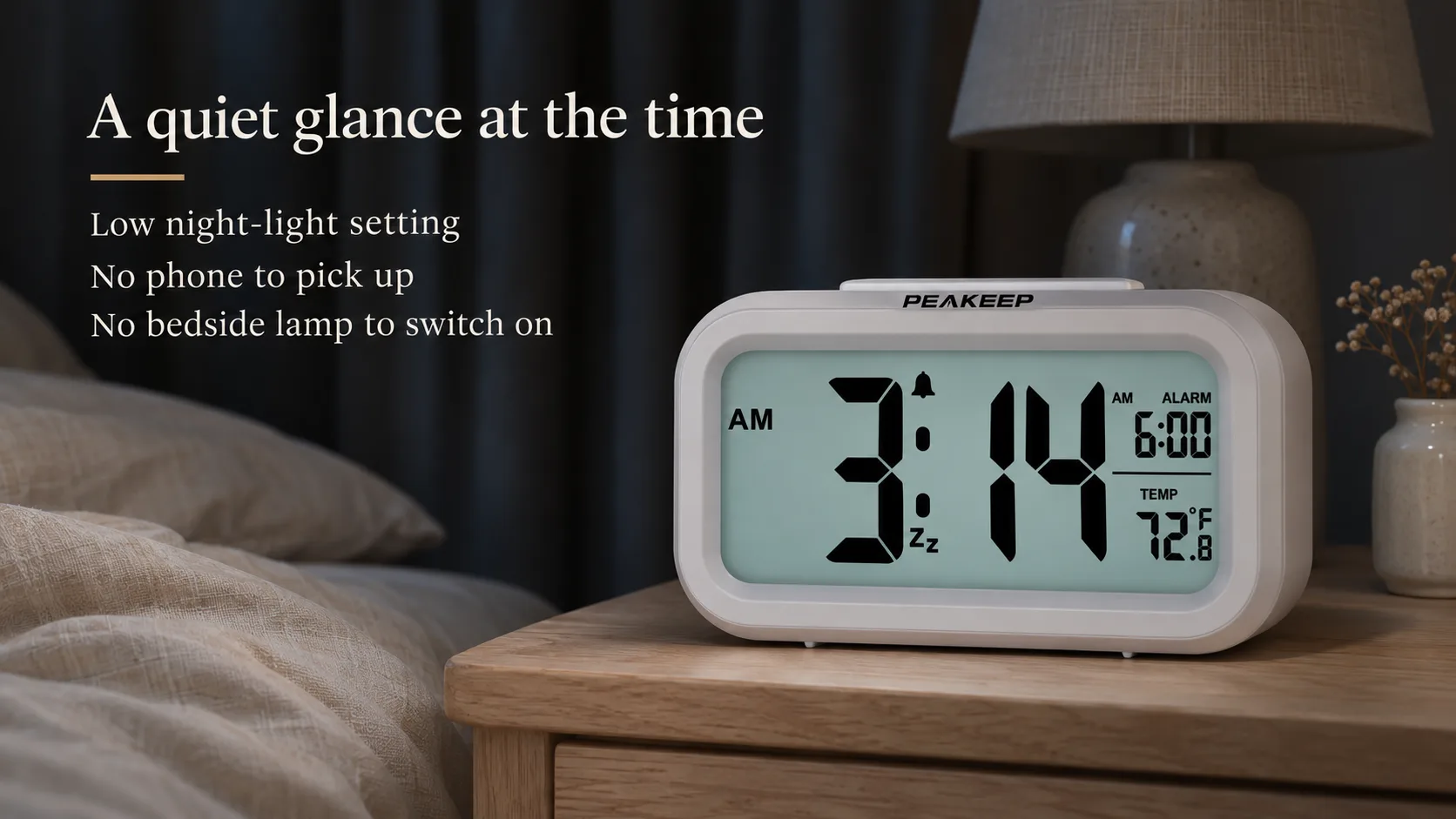
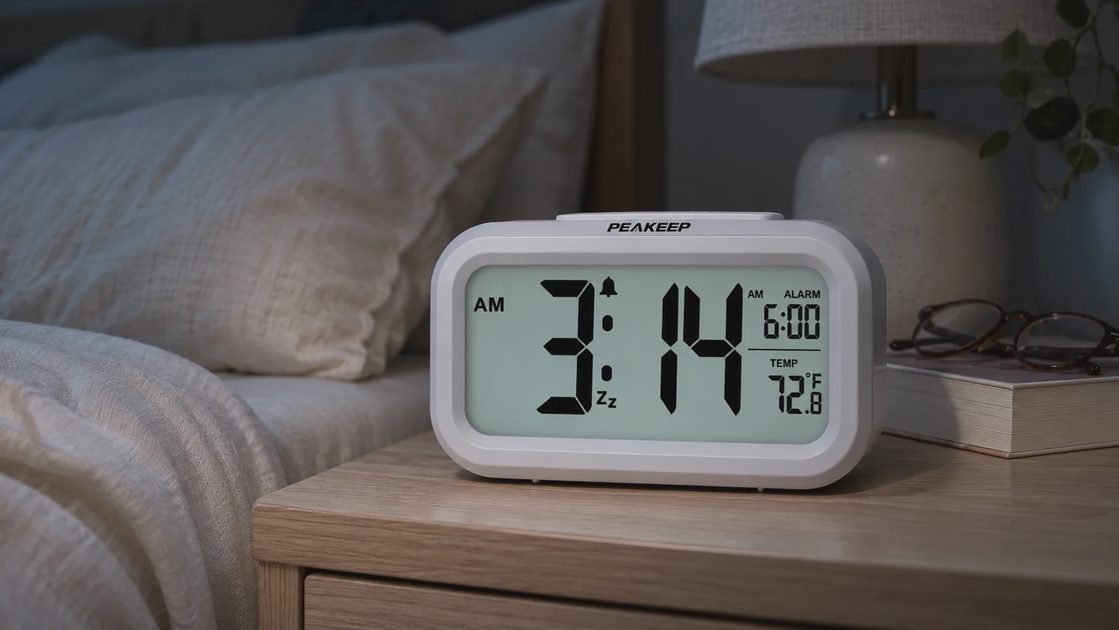
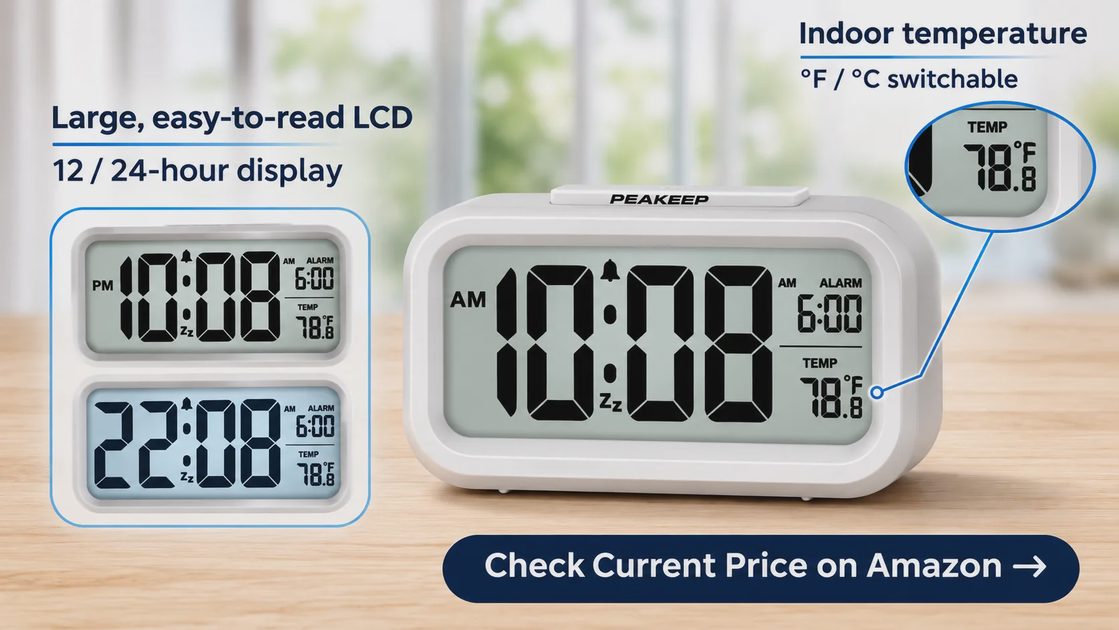
Large, High-Contrast Digits: Bold numerals on the HD LCD screen stay legible from across a typical bedroom or without putting on glasses at night, with easy switching between 12-hour and 24-hour time formats.
Wireless Battery Power: Powered by three AAA batteries (sold separately), giving you flexible, outlet-free placement at home, in dorms, or on the road.
Built-In Indoor Thermometer
At-a-Glance Room Temp: Displays current indoor temperature right on the same screen (15.8°F to 122°F range, ±1.8°F rated accuracy), helping you gauge bedroom or dorm comfort quickly.
Night Light and Ambient Sensor
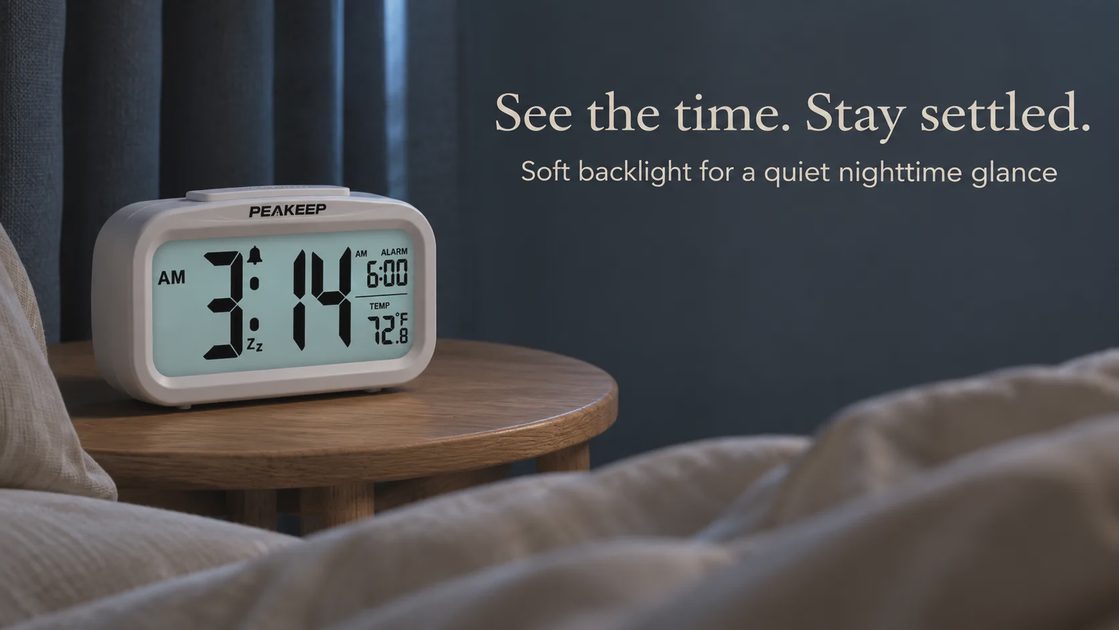
Three-Mode Night Light: Switch freely between Low, High, and Off. When set to Low or High in a dark room, the built-in ambient light sensor automatically triggers a soft backlight so you can check the time without pressing a button or turning on a lamp.
Progressive Alarm and Snooze
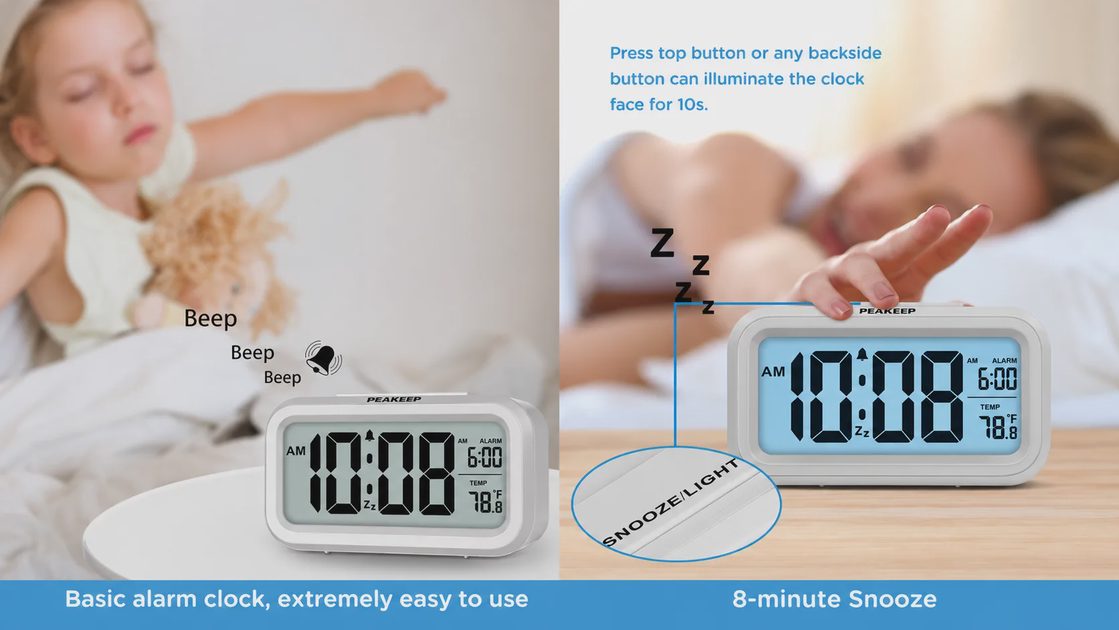
Gradual Crescendo Wake-Up: Uses a progressive beep that starts quieter and gradually speeds up over roughly 90 seconds before stopping automatically—less jarring than a sudden blare and easier on light sleepers or shared spaces.
8-Minute Snooze: A top-mounted snooze button lets you add another 8 minutes of rest when needed.
Who Is It Best For? Real Usage Scenarios
The audience becomes clear after a few weeks of normal use. The strongest match is parents with kids or teens.
Check Current Price on Amazon →
Parents with Kids (Strongest Match)
For parents the main value is that it is enough and not complicated. Children can set the time and alarm themselves. Parents can quickly confirm both time and temperature. The night light turns on automatically in the dark, so you don’t have to switch on the room light when checking on a child. Many parents also use it as a gift that keeps a phone off the nightstand and reduces late-night scrolling. In our house this was one of the practical reasons we kept a second unit in the kids’ room as an alarm clock for kids bedroom use. Our older child (around 10) handled the basic setup without help after a one-time walkthrough.
Teens and Dorm Users
Dorm rooms usually have limited outlets near beds or desks. A fully battery-powered design solves that constraint. The clock is small enough for a desk or bedside table and does not require learning complex settings. The same traits make it useful as a travel battery alarm clock that does not depend on hotel outlets. It functions well as a dorm room alarm clock when space and plugs are tight.
Adults Who Want a Simpler Setup
Some people deliberately stop using their phone as an alarm because the phone on the nightstand leads to more screen time before sleep. They also dislike the pile of charging cables. This clock continues to show the time and can provide a night light during a power outage, so it works as a backup clock or for RV and camping setups where outlets are not always convenient.
Other Situations
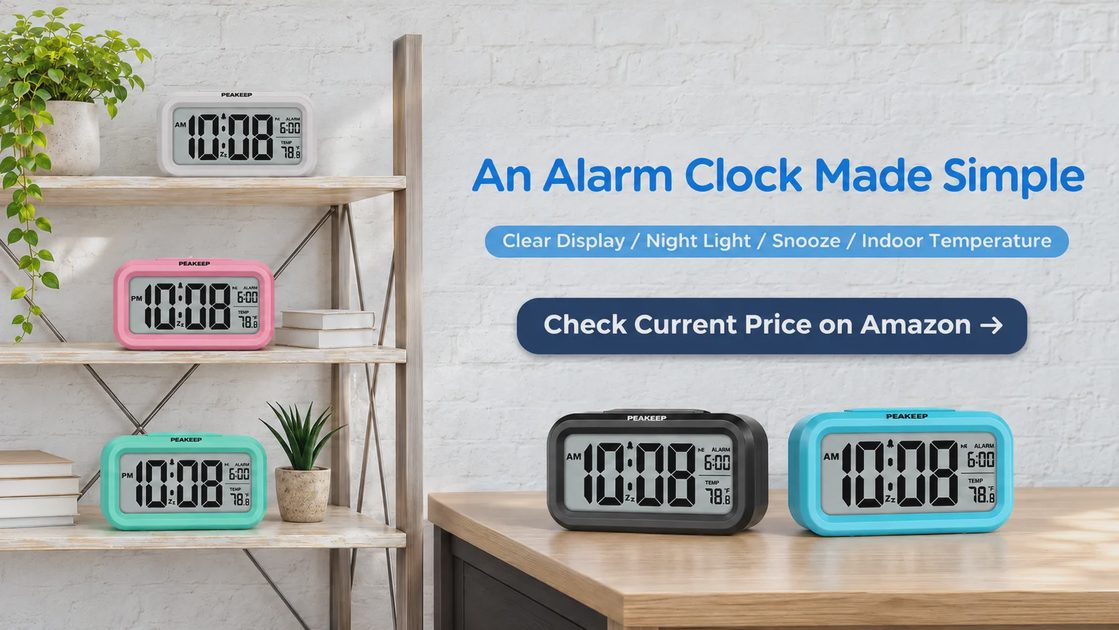
People who prefer large numbers for easier reading, or who are looking for an inexpensive and clean-looking gift (common colors are white or black), often find it suitable. Typical places include the nightstand, desk, travel bag, dorm room, and children’s bedroom. It can also serve as a second clock for someone who wants bigger digits without extra features.
After Using It at Home: The Points That Actually Affect the Buy Decision
Once the clocks were placed in the main bedroom and the kids’ room, the factors that mattered narrowed to a few concrete things. It was not about having more features. It was about whether the time was easy to read at night, how simple the setup felt, whether the time stayed close enough for daily use, and how the batteries performed.
Nighttime Readability (The Point I Cared About Most)
Large numbers plus the adjustable night light were the main reasons we kept them. From the main bed and from the far side of the kids’ desk I can read the time without touching a phone or turning on a lamp. For a household with children this keeps nighttime checks small and quiet. I tested the different brightness levels. In the kids’ room (which has heavier curtains) the Low setting with the automatic sensor is enough to see the numbers without feeling harsh. In the main bedroom I usually leave it on Off because I am more sensitive to light. The three levels plus the ability to turn the light completely off let different rooms find a workable balance. If you are extremely sensitive to any light, it is worth confirming that the Low setting feels acceptable before deciding on long-term bedside use.
Ease of Setup (Especially Important with Kids)
Setup was simpler than I expected. Time and alarm can be set quickly without constantly checking a manual. I let the older child try the clock in their room, and they finished the basic settings on their own after watching me do it once. For parents this removes a recurring task and the worry that a child will not be able to use it.
Timekeeping and Durability (Manage Expectations)
Time accuracy is something I still watch. So far the units in our house have stayed close, but I compare them to a phone every so often. Some users report the clock loses about a minute per week; this is not unusual among battery clocks and is usually handled with an occasional correction. On durability, a portion of feedback mentions units stopping after several months (commonly noted in the three-to-nine-month range). We have not seen that yet, but I treat these as low-cost tools that should be checked periodically rather than devices you never look at again. If you need very high long-term precision, it is better to set that expectation in advance.
Battery Life and Temperature (Real Cordless Experience)
Fully battery-powered operation is another reason we kept them. There is no extra cord on the nightstand, and the same clock works in a dorm or while traveling. The temperature display is a small plus; I glance at it occasionally for a rough sense of room conditions. Battery life depends on how often the night light is used. On Low with rechargeable batteries the runtime is reasonable; higher brightness shortens it noticeably. At roughly $17 plus a set of NiMH rechargeable AAA batteries, the total ongoing cost stays low compared with the hidden cost of phone distraction or replacing a more expensive plug-in clock.
Practical Setup Details: Placement, Glare, and Light Sensor Behavior
Beyond headline specs, day-to-day satisfaction with a small LCD clock comes down to where it sits. Because the Peakeep Night Light Digital Alarm Clock relies on a built-in light sensor when set to Low or High, placement near a window with streetlights or another glowing device can affect how consistently the backlight kicks in. Checking the viewing angle from your normal lying or sitting position—and keeping rear control buttons clear of tight wall gaps or loose cables—helps prevent accidental setting changes and makes quick glances effortless.
How It Compares to Other Bedside Choices
Versus Your Phone: Removes late-night notifications, doomscrolling temptations, and extra charging cords, while trading away customizable multi-alarm schedules and smart features.
Versus Standard Plug-In Clocks: Frees up wall outlets and keeps working during power outages, though budget battery models favor simplicity and low cost over heavy-duty wired hardware.
Versus Precision or Atomic Clocks: Costs far less and stays completely independent of Wi-Fi or radio signals, provided you are comfortable doing an occasional manual time check.
Is It a Fit for You? Quick Conditions
Keep it if you mainly want to see the time easily at night without a phone or extra cord.
Change habits if you pair it with rechargeable batteries and do a quick time check every couple of weeks.
Skip it if you require very high long-term accuracy and durability with almost no maintenance.
Verdict: Is This Budget Alarm Clock Worth Buying?
For the narrow job of seeing the time clearly at night without a phone or another cord, the Peakeep Night Light Digital Alarm Clock does the work at a low total cost. It is a practical everyday tool rather than a precision heirloom. If that matches the friction you actually have, it’s a straightforward option to try. If the friction is minor, there’s little reason to add it.
Check Current Price on Amazon →
Affiliate Disclosure: As an Amazon Associate I earn from qualifying purchases.